
Red imported fire ant (fire ants) (Solenopsis invicta) is one of the worst invasive species to reach Australia.
Fire ants can:
- impact our environment and many industries, including agriculture
- restrict everyday activities such as barbeques, picnics, and sporting events
- inflict painful and potentially fatal stings on people, pets, and livestock
- cause extensive damage to ecological and agricultural systems.
Fire ants are a category 1 restricted matter under the National Environmental Biosecurity Response Agreement.
Detection in Australia
Fire ants were first detected in Australia in Queensland in February 2001.
Response program
An active fire ant eradication response is underway, with Queensland at the forefront of this critical work. The National Fire Ant Eradication Program (NFAEP) is a nationally cost-shared effort, guided by the National Environmental Biosecurity Agreement (NEBRA) to eradicate fire ants from Australia. The Fire ant response plan 2023-2027 focuses on strengthening containment and compliance measures and intensifying community-led treatment.
Eradication activities
Since 2001, the NFAEP has been actively eradicating fire ants in areas of South East Queensland and surrounding regions.
As fire ants are cleared from areas within the eradication treatment area, treatment will move inwards until all areas are treated and fire ants are eradicated. See the Fire ant response plan 2023–27 for more information.
See the fire ant map to view a snapshot of recent fire ant detections in Queensland.
Work is also underway to eradicate fire ants in several areas outside of the NFAEP’s containment boundary. Genetic testing has linked these detections to the original South East Queensland incursion.
See the fire ant outlier detections in Queensland and New South Wales.
New South Wales
On 23 September 2026, a single red imported fire ant nest was detected by the Australian Government Department of Agriculture Fisheries and Forestry (DAFF) at a commercial premises in the Enfield area, NSW. The Australian and NSW governments are working together in response, undertaking further surveillance and monitoring activities in the area.
On 23 November 2023, fire ants were found at South Murwillumbah, triggering an Emergency response from NSW Department of Primary Industries and Regional Development (DPIRD) and the National Fire Ant Eradication Program (NFAEP).
Two further incursions have occurred at Wardell (19 January 2024) and Tweed Heads South (2 July 2025).
Fire ants were also intercepted in a turf delivery to Clunes in November 2024, triggering a suspension of turf moving from the Queensland fire ant infested area into NSW.
NSW DPIRD is working with the NFAEP to complete eradication activities at Murwillumbah, Wardell, and Tweed Heads South. A dedicated NSW Fire Ant Team is working on preparation, prevention and early detection of fire ants in NSW.
Completed responses
Fire ants have been eradicated from Australia on 8 different occasions, including 6 in Queensland and one each in New South Wales and Western Australia.
The state combating the incursion leads the responses in most instances.
See more
How we coordinate a response to an outbreak.
Where fire ants have been eradicated.
Your obligations
If you live or work around affected areas in QLD or NSW, look out for this invasive ant. You must report any suspected sightings.
Report sightings
Report any unusual ants, even if you’re not sure.
Call the Exotic Plant Pest Hotline on 1800 084 881 to report signs of browsing ants.
For signs of exotic pests and diseases in imported goods, sea containers or parcels, call See. Secure. Report on 1800 798 636 or use the online form.
In Qld, call 132 ANT (13 22 68) within 24 hours of sighting, or report online at fireants.org.au.
In NSW, fire ants must be reported via the NSW Biosecurity Helpline 1800 680 244 or online at dpi.nsw.gov.au/fire-ants.
Follow the rules and movement restrictions
Imported goods must meet Australia’s biosecurity conditions. These may include offshore treatment. Check the rules at Biosecurity Import Conditions system (BICON).
Movement restrictions are mandated at infested sites. You must adhere to them. They ensure the ant is not moved out of infested areas or interstate.
See more about response activities and restrictions in each state:
About the pest
Fire ants are an exotic invasive ant and an environmental pest.
The ant is native to South America. It has spread to the United States, China, Taiwan, Japan, the Philippines and Australia.
Exotic invasive ants are included on:
- National Priority Plant Pest List (2019)
- National Priority List of Exotic Environmental Pests, Weeds and Diseases (2020)
What to look for
Fire ants are copper brown in colour, with a darker abdomen. They measure 2-6mm in length and are highly aggressive when disturbed. A single fire ant nest can contain many different sized ants.
Fire ants can adapt to most climates and environments around the world. They invade outdoor spaces.
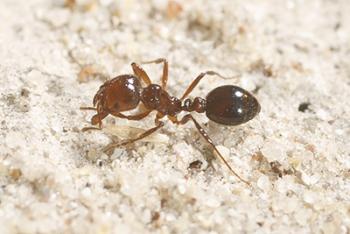
Watch
See Fire ant identification video
How it spreads
Fire ants are highly mobile. They can fly up to 5km and travel over and underground. They can also raft on waterways after floods or rain.
They can stowaway on goods and vehicles and can move with shipping containers and cargo.
Fire ants can also spread when people move:
- high-risk materials such as soil, hay, mulch, manure, mining and quarry materials, turf, and potted plants
- materials or vessels stored on the ground, in contact with soil or organic matter, or exposed to the environment, such potted plants, pallets, and temporary fencing
- dirty machinery that has been used to move material.
What you can do to stop the spread
Clean all equipment and machinery properly, including slashers, excavators, wheelbarrows, and other gear. This ensures it is free from soil and other materials that fire ants like to nest in.
Make sure all traces of soil, hay, turf, potted plants, or processed materials are removed.
You can use one or more of the following methods:
- ✔ Scraping or blowing
- ✔ Brushing down
- ✔ Washing down
- ✔ Steam cleaning
- ✔ Air-blasting with an air compressor